鯉 · KOI
Koi
Symbol of resistance, determination, and ultimate success — the fish that fights the current to become a dragon.
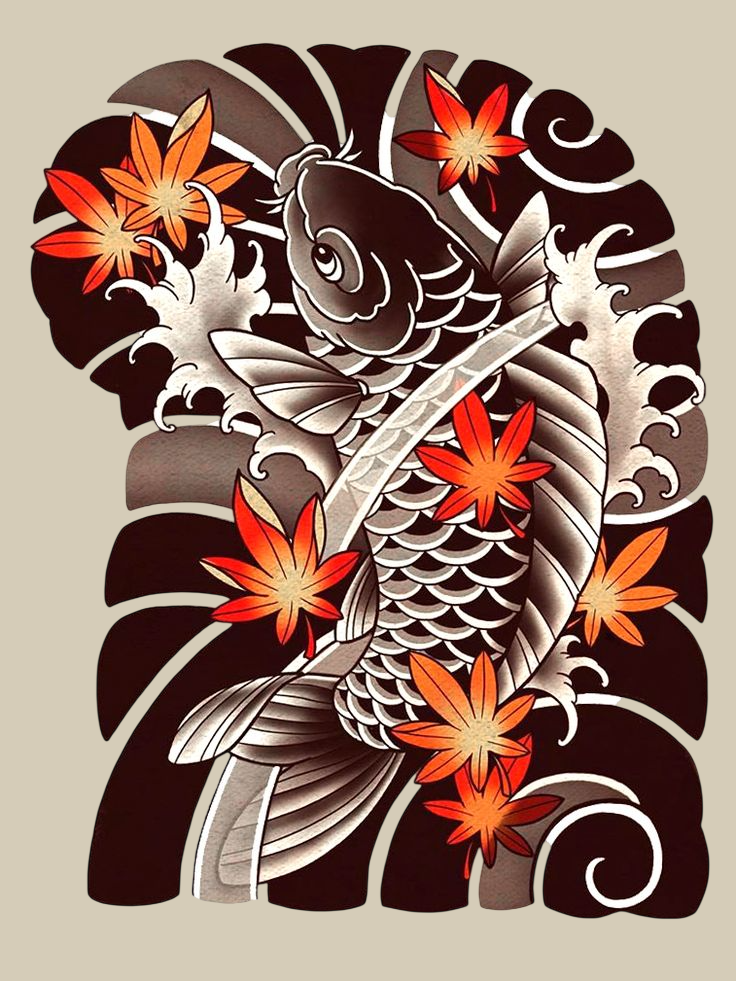
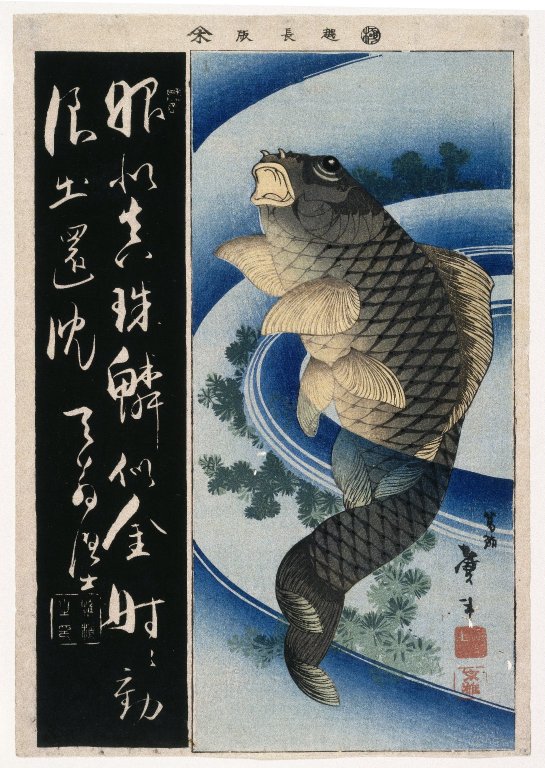
The koi is one of the most iconic animals in Japanese culture, and few irezumi motifs are more masculine. Strong enough to swim upstream and leap up to ten feet out of the water, the carp became the emblem of perseverance — of pushing against the current until the goal is reached.
It is also the emblem of Kodomo no hi (こどもの日), Children's Day on May 5th, when painted carp banners — koinobori (鯉のぼり) — are flown above houses across Japan to wish strength and health on the children inside. On the streamers the black carp (magoe) is the father, the red (higoe) the mother, and the blue or other colors (kogoe) the children. The same pairing of black and red, swimming in a circle, becomes a yin-yang.
Koi can live up to a hundred years, and that longevity gives the fish a second meaning: a happy marriage and a long life together. Two carp swimming as a pair stand for an enduring couple — a reading reinforced by the kanji 恋, which means "love" and is also pronounced koi.
In the nineteenth century, rice farmers in Niigata began breeding common carp for color, separating the brightest specimens into their own ponds and calling the resulting patterns "living flowers." Enthusiasm spread nationwide after Emperor Hirohito introduced koi to the Imperial Palace pond in 1914; the upper classes — and the imperial family itself — adopted the fish as their own. Today, prize specimens fetch more than a hundred thousand euros, and koi ponds are an ornamental fixture of shrine gardens.
Famous narrative motifs
The stories behind the koi
Specific legends and figures that appear again and again in irezumi — each one its own composition with its own rules.
- 01登龍門
Toryumon — The Dragon Gate
The Chinese legend of the Yellow River tells of a stretch of rapids so fierce that only the strongest carp can climb them. Those that succeed cross "the dragon's gate" and are transformed, taking on the body of a dragon and living forever in the heavens.
From this comes the Japanese expression toryumon — "passing through the dragon's gate" — used to mean overcoming a barrier on the way to success. In tattoos the moment of transformation is depicted directly: a carp with the emerging features and head of a dragon. This hybrid form has its own name, koiryu (鯉龍).
Source · Chinese in origin, naturalised into Japanese tattoo iconography through the ukiyo-e of the Edo and Meiji periods.
- 02金太郎
Koitaro — Kintaro and the Carp
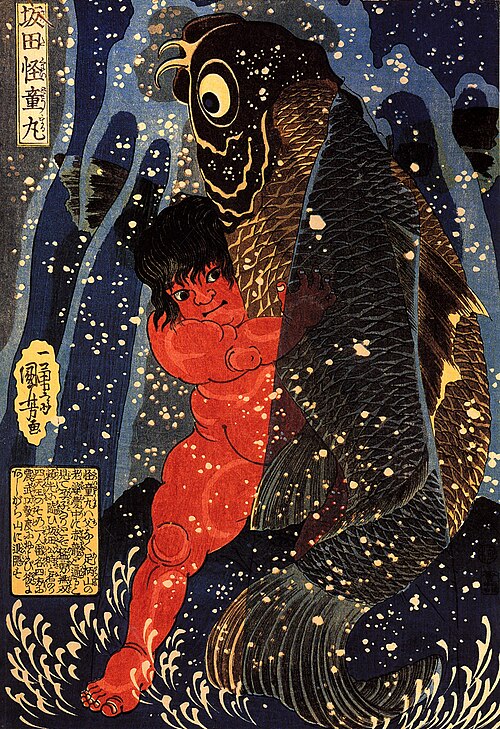
Kintaro, the "golden boy," is one of Japan's most popular mythological heroes — a child of Herculean strength raised in the mountains by a kind of ogre, who demonstrates his power by wrestling the animals of the forest. In the ancient legends, Kintaro never actually fought a carp.
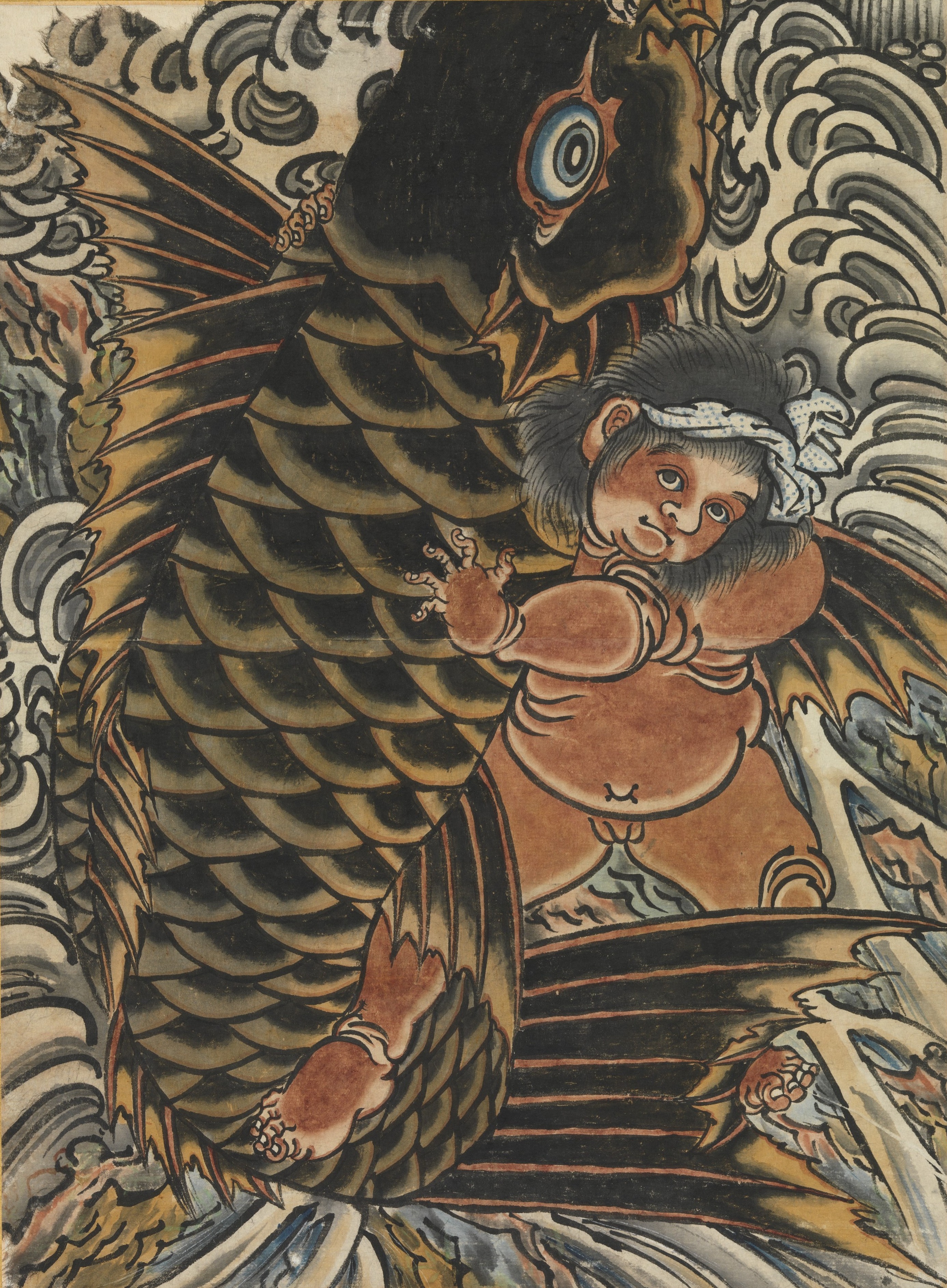
The motif of the boy clinging to a giant koi was invented by the illustrator Kuniyoshi, who fused the Kintaro story with the legend of Benkei. The resulting composition — known as koitaro — became one of the defining images of irezumi.
Source · Invented by Utagawa Kuniyoshi, late Edo period (early 19th c.).
- 03弁慶 / 鬼若丸
Benkei and the Giant Carp
The warrior-monk Benkei, brother-in-arms of Minamoto no Yoshitsune, is one of the most famous figures in Japanese folklore. As a boy he was called Oniwakamaru — "young demon child" — and it was then that he watched his mother be taken by a giant carp at the Bishamon falls.
He spent years waiting at the foot of the falls for the carp to return. When it finally rose again, the young Oniwaka leapt onto its back, clung to it, and stabbed it with his katana until it died. Only afterwards did he realise the fish had been the ghost of his own mother — for whenever an oversized animal appears in legend, it is usually a yokai (妖怪), a supernatural being.
The image of the child latched onto the back of the carp is one of the most popular tattoo motifs in Japan.
Source · Japanese folklore.
- 04観音
Kannon — The Water Mother
Kannon (known in China as Kuan-yin) is not a goddess but a bodhisattva: an enlightened being who has vowed not to ascend to the heavens until every human attains enlightenment too. She bestows mercy, hears the prayers of those in difficulty, and answers the prayers of those who wish to have children — which is why she is called the "mother of mercy."
She is usually depicted standing on a lotus, a koi, or a dragon, carrying a bottle from which all the world's waters flow. For this she is also known as the "water mother." Mounted on her dragon, she rescues humans from water, fire, and the sword; on a lotus she is a talisman for those who cannot conceive.
Source · Buddhist iconography, common across East Asia.
Artwork — the koi in practice
"The koi does not become a dragon by being strong. It becomes one by refusing, for long enough, to stop."
What it's saying
In context
The meaning shifts with direction, pairing, and composition. A short label is never the whole answer.
Swimming upstream
A koi facing up the body, fighting the current, is the classic image of perseverance — the moment before transformation in the Dragon Gate legend. It reads as ambition, struggle against odds, and self-made strength.
Swimming downstream
A koi turned with the current is read as having already arrived — achievement, contentment, or a goal reached. Less common in irezumi, where the upstream fight carries more weight.
Koi + cherry blossom
A traditional pairing, though debated. Cherry blossoms bloom in spring, exactly when koi are at their most lethargic, not yet moving upriver. Traditionalists see a contradiction in both mood and season. Modern artists pair them anyway, drawn to the contrast of soft falling petals against a heavy, muscular fish.
Koi + maple leaves
A classical autumn pairing, though debated. Some masters prefer maple leaves over cherry blossom as the natural companion to koi — both belong to the same seasonal world of moving water and falling color. Maple leaves, however, carry the meaning of death and the end of a cycle, while the koi stands for longevity and endurance.
Koi + lotus
The lotus rises clean from muddy water; the koi pushes up through the same water. Together they double the idea of purity earned through struggle. Common in Buddhist-leaning compositions.
Koi + peony
Peony is wealth and nobility, koi is perseverance. The pairing reads as success and royalty
Koi + dragon
Direct reference to Toryumon — the carp that climbs the Dragon Gate and becomes a dragon. Often shown as the same animal mid-transformation (koiryu), with scales becoming claws.
Two carp together
Two koi swimming together symbolize a happy marriage and a long life shared. The reading is reinforced by the kanji 恋 — meaning "love" — which is also pronounced koi. Often composed as a yin-yang, with black and red carp circling each other.