蛇 · SNAKE
Snake
Neither fully good nor fully evil — the snake sheds its skin, guards its shrine, and has been both worshipped and feared since the earliest days of Japanese myth.
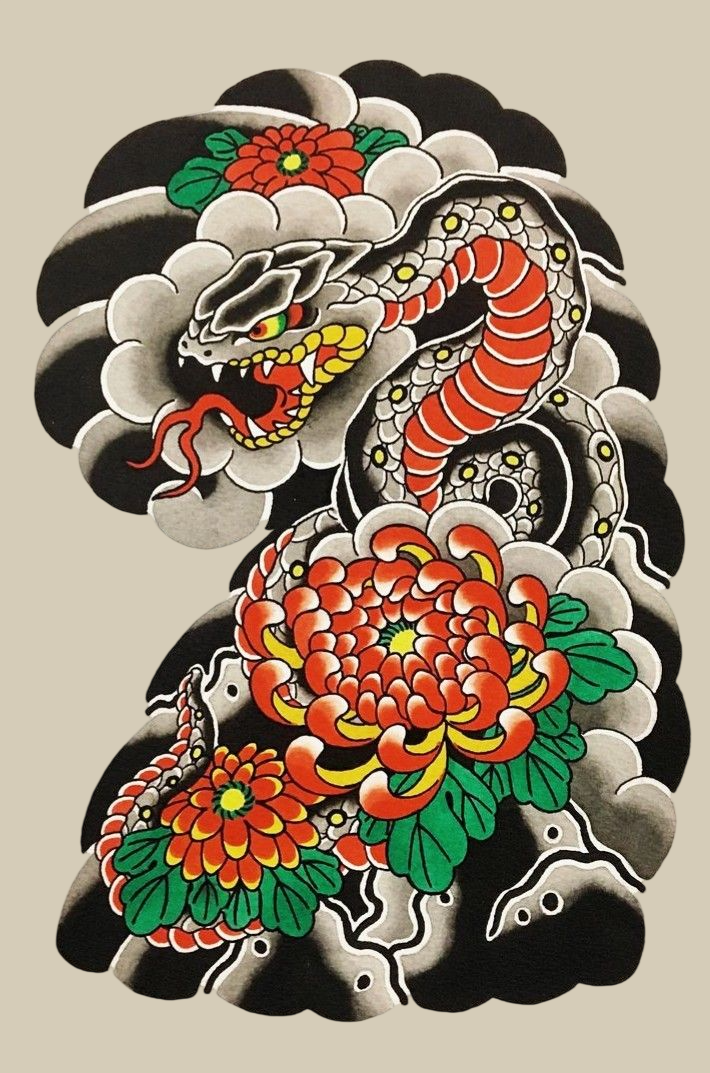
The snake carries one of the most layered sets of associations in all of irezumi. It is protective and dangerous in the same breath — connected to water like the dragon, seen as immortal because it sheds its skin and emerges renewed. In the past, killing a snake was considered an act that would eventually bring poverty or grief. Seeing a white one was an omen of great fortune.
The deity Ugajin (宇賀神) — human head, serpent body — was the god of harvest, fertility and good fortune. Stories from the 15th century onward tell of shrines built in his honor and blessings received in return. The white snake, shirohebi, occupies a similar sacred space: rare enough in Japan that its appearance alone was considered a divine signal. Shinto shrines are dedicated to white snakes specifically.
The snake is also connected to Benzaiten — the goddess of everything that flows: water, music, words, and wealth. One of the Seven Gods of Fortune, she is closely associated with the snake, which serves as her messenger and guardian. Her shrines are almost always found near water, and white snakes are considered her divine emissaries. The connection deepens the snake's association with good fortune and adds a layer of feminine divine power to the motif.
Because the snake sheds its skin and emerges renewed, it also became a symbol of healing and recovery in Japanese tradition — not just immortality in the abstract, but the very specific idea of the body repairing itself, of illness left behind like an old skin.
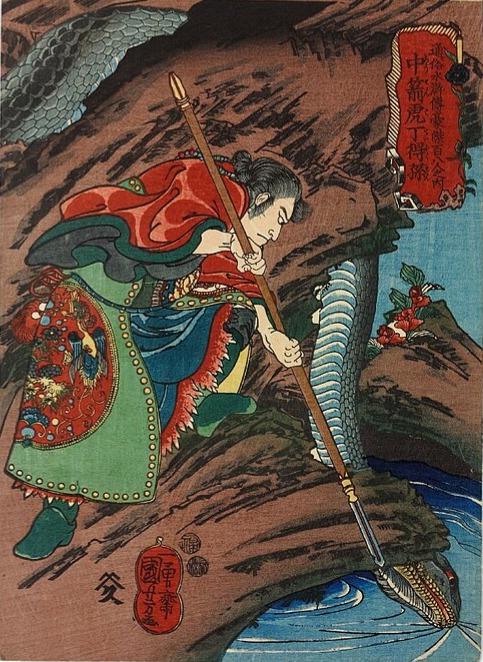
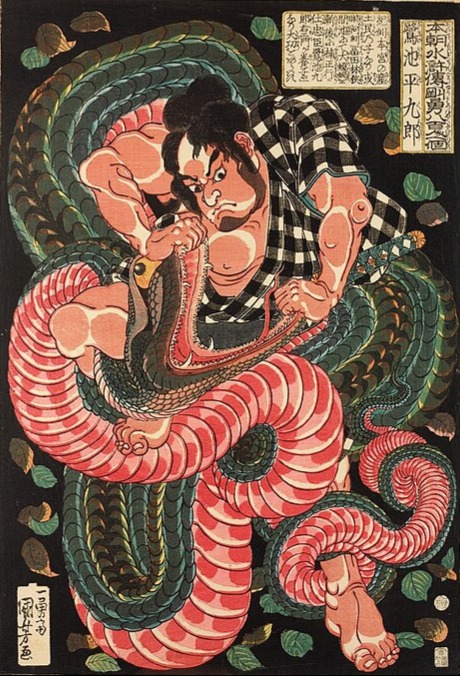
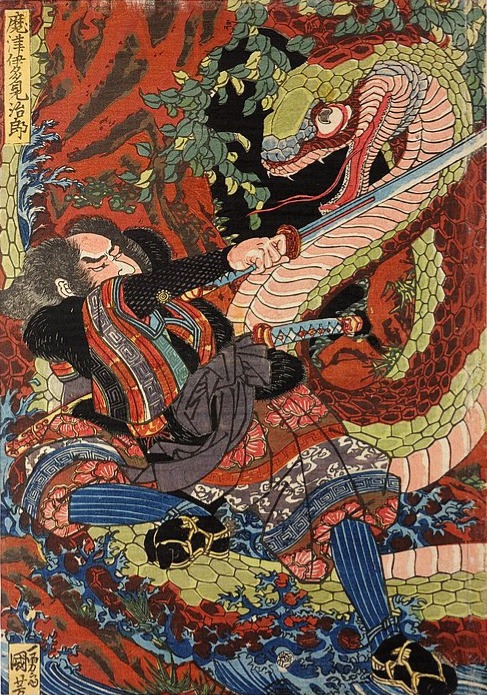
The snake also carries the weight of the Yamata no Orochi (八岐大蛇) — the legendary eight-headed serpent of destruction, brought down by the god Susanō. In early Japanese visual tradition serpents and dragons were used interchangeably, and the Orochi carried qualities of both. Tales of giant serpents causing chaos run throughout Japanese folklore, with heroes and villains alike defined by how they faced them.
In irezumi the snake follows strict seasonal logic. It hibernates through winter and emerges in spring, so its natural companions are spring and summer motifs — peony, cherry blossom, flowers in bloom. Autumn pairings such as maple leaves exist and are acceptable. Winter motifs — pine, plum, bamboo — do not work, as the snake would still be underground. In its darker readings the snake pairs with the Hannya mask, binding its dangerous and sexual qualities to themes of jealousy, obsession and consuming rage.
Famous narrative motifs
The stories behind the snake
Specific legends and figures that appear again and again in irezumi — each one its own composition with its own rules.
- 01八岐大蛇
Yamata no Orochi
The Yamata no Orochi is the great destructive serpent of Japanese mythology — eight heads, eight tails, a body so vast it stretched across eight valleys and eight hills. It terrorized the land until the storm god Susanō descended and defeated it, cutting it apart and discovering within its tail the sacred sword Kusanagi, one of the three imperial treasures of Japan. The story is one of the oldest in Japanese myth, recorded in the Kojiki. In early visual tradition, serpents and dragons shared the same imagery — the Orochi was drawn with qualities of both, and the line between them was deliberately blurred.
Source · Recorded in the Kojiki (712 AD), Japan's oldest chronicle.
- 02宇賀神
Ugajin — The Serpent God of Fortune
Ugajin is a Shinto deity depicted with the head of an elderly human and the coiling body of a snake. He governs harvest, fertility and good fortune — one of the more benevolent faces the snake wears in Japanese belief. Shrines were built to him from at least the 15th century, and tradition holds that those who honored the snake received prosperity, while those who killed one would eventually face poverty or grief. The same belief system that produced shrines to white snakes — shirohebi — flows from this same root: the snake as something sacred, not merely feared.
Source · Ugajin worship documented from the 15th century onward in Japanese Shinto tradition.
- 03弁財天 / Benzaiten
Benzaiten and the White Snake
Benzaiten is one of the Seven Gods of Fortune and the only female among them — the goddess of everything that flows: water, music, eloquence, and wealth. The snake is her messenger and guardian, and white snakes in particular are considered her divine emissaries. Her shrines are almost always found near water — rivers, lakes, islands — and it is common to find snake imagery woven into their decoration. The connection gives the snake a dimension beyond danger and immortality: through Benzaiten it becomes a carrier of abundance, artistic talent, and the kind of fortune that flows rather than sits still.
Source · Shinto and Buddhist traditions
Artwork — the snake in practice
"The snake does not die. It simply leaves its old self behind."
What it's saying
In context
The meaning shifts with direction, pairing, and composition. A short label is never the whole answer.
Snake + peony or cherry blossom
The snake's most natural pairing in irezumi follows seasonal logic. The snake hibernates through winter and surfaces in spring — so cherry blossom and peony, both spring motifs, are its correct companions. The combination marks a specific moment: emergence, renewal, the return of something that was dormant.
Snake + maple leaves
An autumn pairing, less common than spring but accepted within traditional convention. Maple leaves signal the approach of the cold months — the time when the snake will soon return underground. The pairing carries a quiet sense of ending rather than beginning.
Snake + Hannya mask
The darkest pairing the snake carries. The Hannya mask represents a woman consumed by jealousy and rage, transformed into a demon by obsession. Combined with the snake — dangerous, sexual, coiling — the image moves into territory of destructive desire and consuming emotion. One of the most charged combinations in all of irezumi.
White snake — shirohebi
A white snake is a rare sight in Japan and carries an entirely different reading from the common snake. It is sacred rather than dangerous, an omen of good fortune rather than a symbol of risk. Shinto shrines are dedicated specifically to white snakes, and they are considered the divine emissaries of Benzaiten. In irezumi a white snake shifts the entire meaning of the motif toward divine protection and incoming luck.