蛸 · OCTOPUS
Octopus
Physician to the sea dragon, subject of Japan's most notorious woodblock print, and one of irezumi's most visually dynamic creatures.
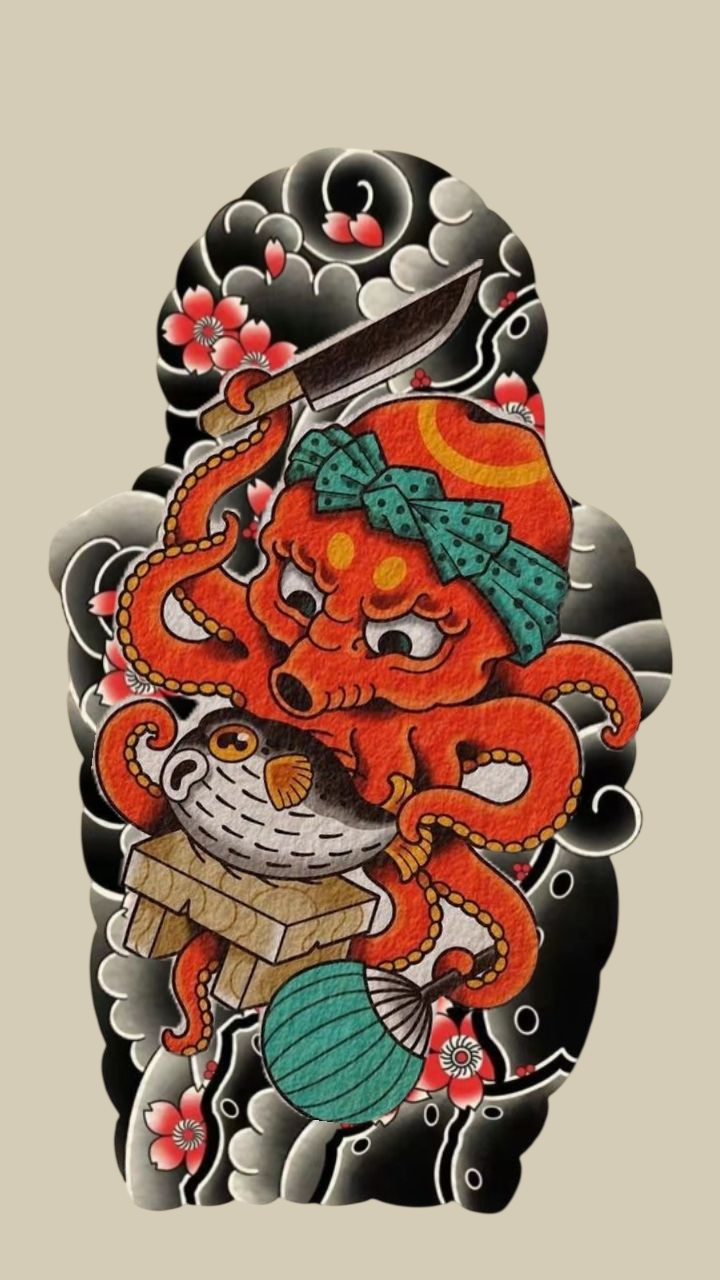
The octopus — tako — occupies an unusual place in irezumi. It is not a creature of land or sky but of the deep, and its world is Ryujin's world: the underwater palace, the realm of the sea dragon king. In Japanese tradition the octopus served as personal physician to Ryujin, which explains why Japanese doctors of the past were known to carry octopus amulets — the association between the creature and healing ran deep enough to cross from mythology into medical practice.
The octopus carries a secondary reading through its ink. In irezumi the creature's ability to release ink in the water became a quiet visual pun — the tattoo artist's ink and the tako's ink occupying the same word, the same act of marking. It is one of the few motifs in irezumi that comments on the art form itself.
The most famous image connecting the octopus to Japanese art predates irezumi's golden age. In 1814 Hokusai produced The Dream of the Fisherman's Wife — a woodblock print depicting an intimate encounter between a woman and an octopus that became one of the most discussed and reproduced works in the history of Japanese art. The erotic charge of tentacles in Japanese visual culture begins here, with one of the country's most celebrated artists. The motif was not considered scandalous in its time — it was considered masterful.
In the north, the Ainu people of Hokkaido held a different but equally powerful relationship with the octopus through the figure of Akkorokamui — a colossal octopus-like deity of the sea, worshipped as a healer. Because the octopus can regenerate severed limbs, the Ainu believed Akkorokamui possessed the power to heal broken and disfigured bodies. The creature was both feared for its size and revered for its restorative power.
Famous narrative motifs
The stories behind the octopus
Specific legends and figures that appear again and again in irezumi — each one its own composition with its own rules.
- 01蛸と海女 / Tako to Ama
The Dream of the Fisherman's Wife
In 1814 Katsushika Hokusai produced one of the most audacious images in the history of Japanese art — a woodblock print showing a pearl diver in an intimate encounter with two octopuses. It was published openly, as part of a mainstream illustrated book, by one of Japan's most celebrated artists. In its time it was not scandal but craft — a demonstration of Hokusai's mastery and an expression of a tradition of erotic art that was accepted within Japanese visual culture. The image established the octopus as a creature of desire and the unconscious in Japanese art, and its influence runs through irezumi to the present day.
Source · Kinoe no Komatsu, vol. 3, Katsushika Hokusai, 1814.
- 02玉取り / Tamatori Monogatari
Tamatori — The Jewel Taker
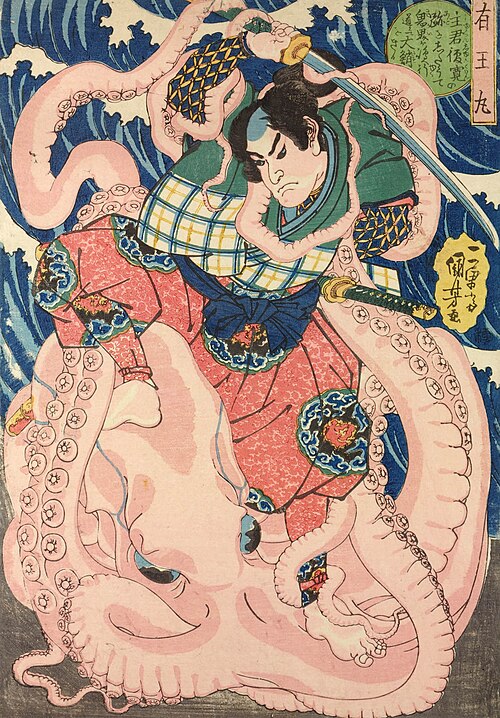
One of the most depicted stories in ukiyo-e and irezumi: a woman — in some versions a fisherman's wife, in others a legendary diver named Tamatori — descends to the underwater palace of Ryujin to retrieve a precious jewel stolen by the sea dragon king. She fights her way through sea creatures, retrieves the jewel, and cuts open her own breast to hide it from her pursuers before surfacing. The octopus appears as one of the palace guardians she must overcome. The story combines courage, sacrifice, and the terror of the deep — all territory the octopus inhabits naturally in irezumi.
Source · Japanese folklore, depicted extensively by Utagawa Kuniyoshi and others
- 03アッコロカムイ
Akkorokamui — The Healing God of the Deep
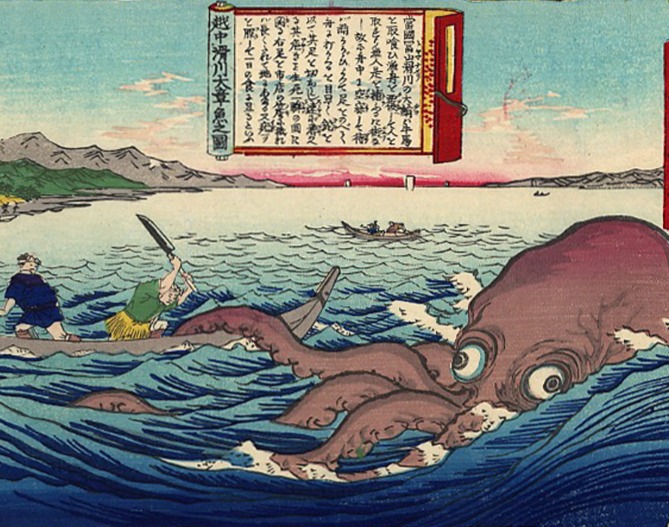
In the mythology of the Ainu — the indigenous people of Hokkaido — Akkorokamui is a vast octopus-like deity that dwells in the sea. So enormous it could swallow boats and whales whole, it was both feared and venerated. The Ainu believed that because the octopus can shed and regrow its limbs, Akkorokamui possessed the power to heal those with broken, severed, or disfigured bodies. Prayers were offered to it for physical restoration. The creature represents a different current in Japan's octopus mythology — not erotic or playful, but primordial and healing, a god of the deep that gives back what the sea takes away.
Source · Ainu oral tradition, Hokkaido. Documented in ethnographic records of Ainu belief systems.
Artwork — the octopus in practice
"In the deep, the octopus sees everything and reveals nothing."
What it's saying
In context
The meaning shifts with direction, pairing, and composition. A short label is never the whole answer.
The ink visual pun
The octopus releases ink to escape predators — and the tattoo artist applies ink to skin. In Japanese the connection between the two is close enough to function as a deliberate visual pun in irezumi compositions. The octopus is one of the few motifs that quietly references the act of tattooing itself.
Tako + Ryujin imagery
As personal physician to Ryujin, the sea dragon king, the octopus belongs naturally to underwater palace compositions. When shown alongside Ryujin or in deep water settings it reads as a creature of the divine undersea world — a servant of something far greater than itself, and a keeper of that world's secrets.
Tako as healer
Through both the Akkorokamui tradition and the old Japanese practice of carrying octopus amulets, the creature carries a healing reading that is easy to miss behind its more dramatic associations. In irezumi this reading is subtle but present — the octopus as something that regenerates, recovers, and restores.