狐 · KITSUNE/FOX
Kitsune/Fox
The fox that walks between worlds — trickster, messenger, and shapeshifter.
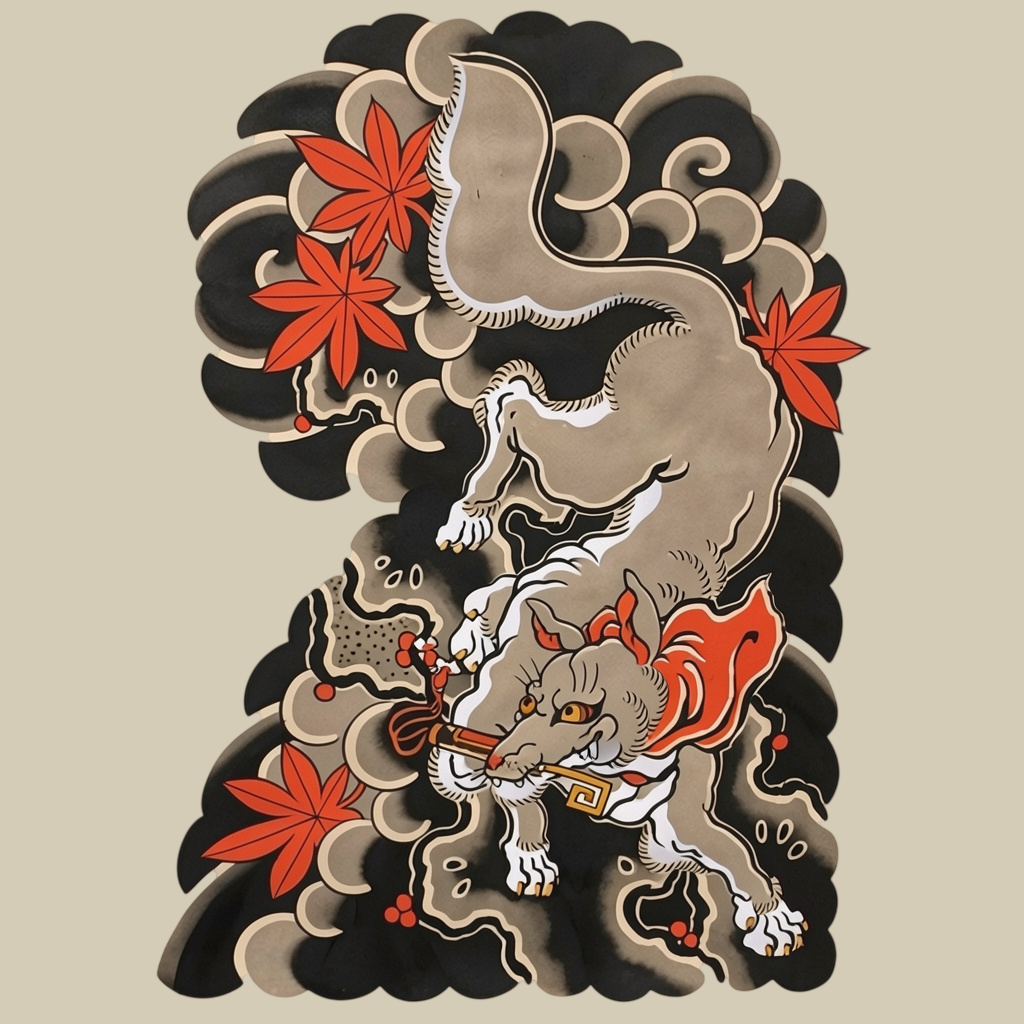
The kitsune is one of the most complex and contradictory creatures in Japanese mythology. It is neither purely good nor purely evil — it is both, sometimes within the same story. As a divine messenger of the god Inari it protects harvests and answers prayers. As folklore's great trickster it bewitches, deceives, and leads people toward ruin. The Japanese have always known it can go either way.
Foxes are elusive by nature — moving at night, rarely seen, leaving only traces of their passage. That elusiveness gave rise to the belief that they possessed supernatural powers. In China they were thought to be spirits of the dead, haunting cemeteries after dark. In Japan the mythology went further: the older a fox grows, the more powerful it becomes.
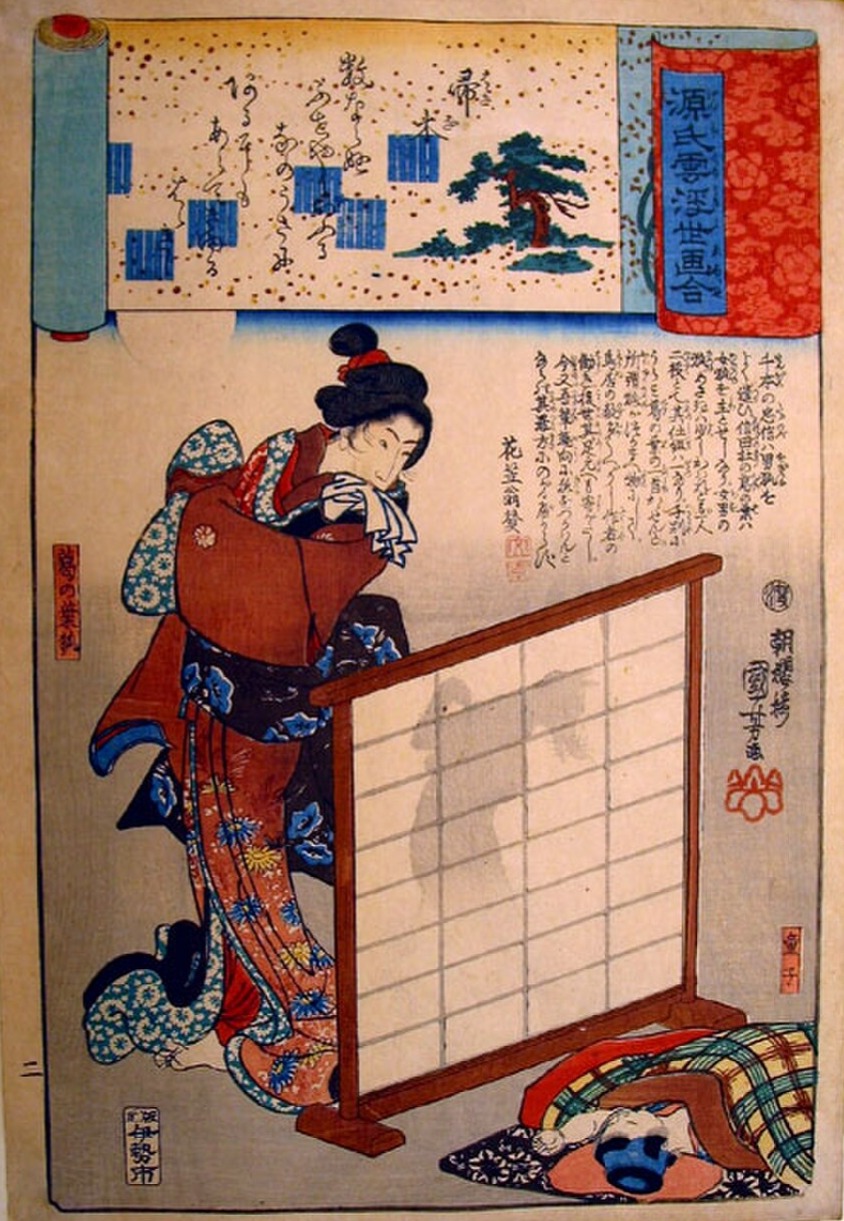
At one hundred years old a fox grows a second tail and gains the power of henge (変化) — the ability to transform into a human being, almost always a beautiful woman. It can then bewitch people, guiding them into dangerous situations, illuminating its path with kitsunebi (狐火), a ghostly fire that emerges from its tails. It can never fully become human — its tail always betrays it, visible in water's reflection. A dog, legend says, is the only reliable defence.
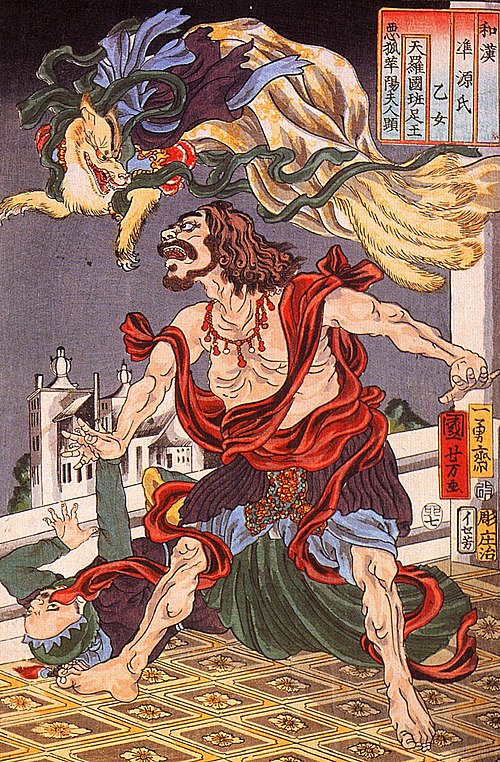
At one thousand years, the fox grows nine tails and becomes kyubi no kitsune (九尾の狐). Its fur turns silver, white, or gold. It gains the ability to see and hear every event in the world, and some attain infinite wisdom. Black foxes bring good luck; white ones are omens of misfortune; three together presage catastrophe.
The kitsune always carries a hoshi no tama (ほしのたま) — a star ball, a jewel that holds part of its power when it changes form. Whoever steals it can force the fox's obedience. Some traditions say the jewel houses the fox's soul itself: separated from it, the kitsune dies.
Famous narrative motifs
The stories behind the kitsune/fox
Specific legends and figures that appear again and again in irezumi — each one its own composition with its own rules.
- 01玉藻前
Tamamo-no-Mae
The most famous kitsune in Japanese legend is Tamamo-no-Mae — a bewitchingly beautiful woman who became a favored consort of Emperor Konoe in the 12th century. As the emperor grew mysteriously ill, a diviner revealed that his companion was in fact a nine-tailed fox. She fled, was hunted across Japan by imperial troops, shot with an arrow, and transformed into a massive boulder — the Sessho-seki, or Killing Stone — said to emit poisonous vapors lethal to anything that touched it.
Source · One of the three great evil spirits of Japanese legend.
- 02狐女房
The Fox Wife
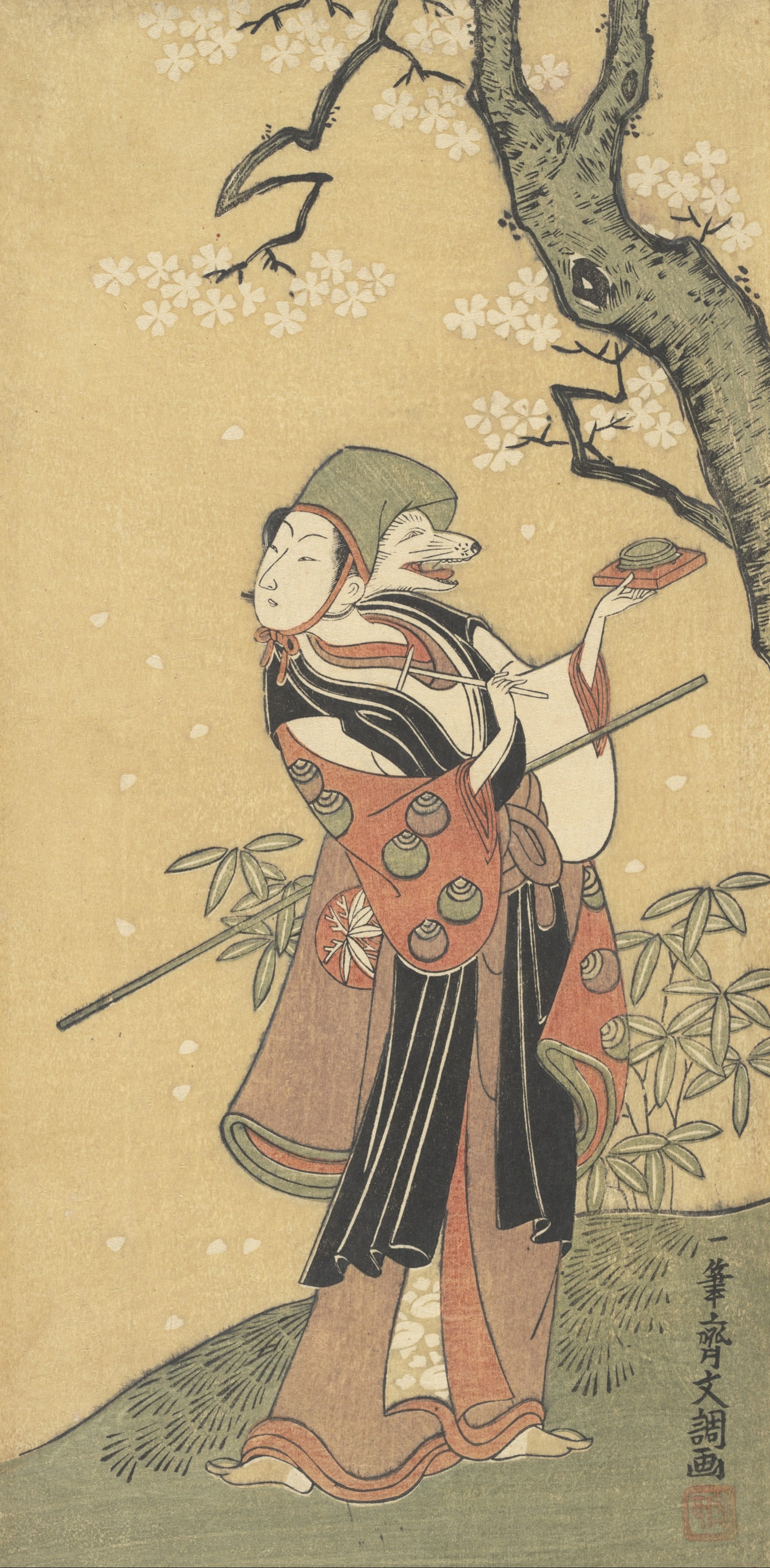
A recurring figure in Japanese folklore: a kitsune takes the form of a beautiful woman, marries a man, and lives with him — sometimes for years, sometimes bearing children — until a dog or a reflection in water reveals her tail. Discovered, she vanishes. The stories are told as tragedies as much as warnings. The man loses everything he thought he had. She loses the only world where she was fully herself.
Source · Japanese folktale
- 03稲荷大神
Inari and the Fox Messengers
Inari is the Shinto deity of rice, fertility, agriculture, and commerce — and the kitsune is Inari's messenger. Across Japan there are some ten thousand Inari shrines, each guarded by a pair of stone foxes: one male, one female, one carrying a jewel-tipped tail, one carrying the hoshi no tama. The most celebrated is Fushimi Inari in Kyoto, where thousands of vermillion torii gates climb the mountain so closely that a person walking beneath them stays dry in rain. Offerings of fried tofu are left for the foxes — their favorite food, which eventually gave its name to kitsune udon.
Source · Fushimi Inari, Kyoto. Inari worship documented from the 8th century onward.
Artwork — the kitsune/fox in practice
What it's saying
In context
The meaning shifts with direction, pairing, and composition. A short label is never the whole answer.
One tail vs nine tails
The number of tails is the clearest signal of a kitsune's age and power. One tail is a young fox, still learning. Nine tails — kyubi no kitsune — is a creature a thousand years old, with near-infinite wisdom and the ability to perceive all events in the world. The color shifts too: the nine-tailed fox's fur turns silver, white, or gold.
Kitsune mid-transformation
A fox shown with a human body but a fox head — or a woman whose tail is just visible — depicts the moment of revelation: the instant the disguise breaks. In irezumi this is one of the most charged compositions the motif offers. It sits at the boundary between two worlds, belonging fully to neither.
Kitsune + Inari
When paired with shrine imagery or the figure of Inari, the kitsune reads as divine messenger rather than trickster — a protector of harvests, a bringer of good fortune, a guardian. The same animal, different context, entirely different meaning.
Kitsune standing on skull
A fox with a paw over or standing on a skull takes a dominant stance over death itself. The reading is clear: what others fear, the kitsune commands.
Zenko vs Yako
Not all kitsune are the same. Zenko are benevolent foxes aligned with Inari — protectors, messengers, bringers of good fortune. Yako are wild foxes: tricksters at best, deadly at worst. The same animal carries entirely opposite meanings depending on which tradition you follow.